
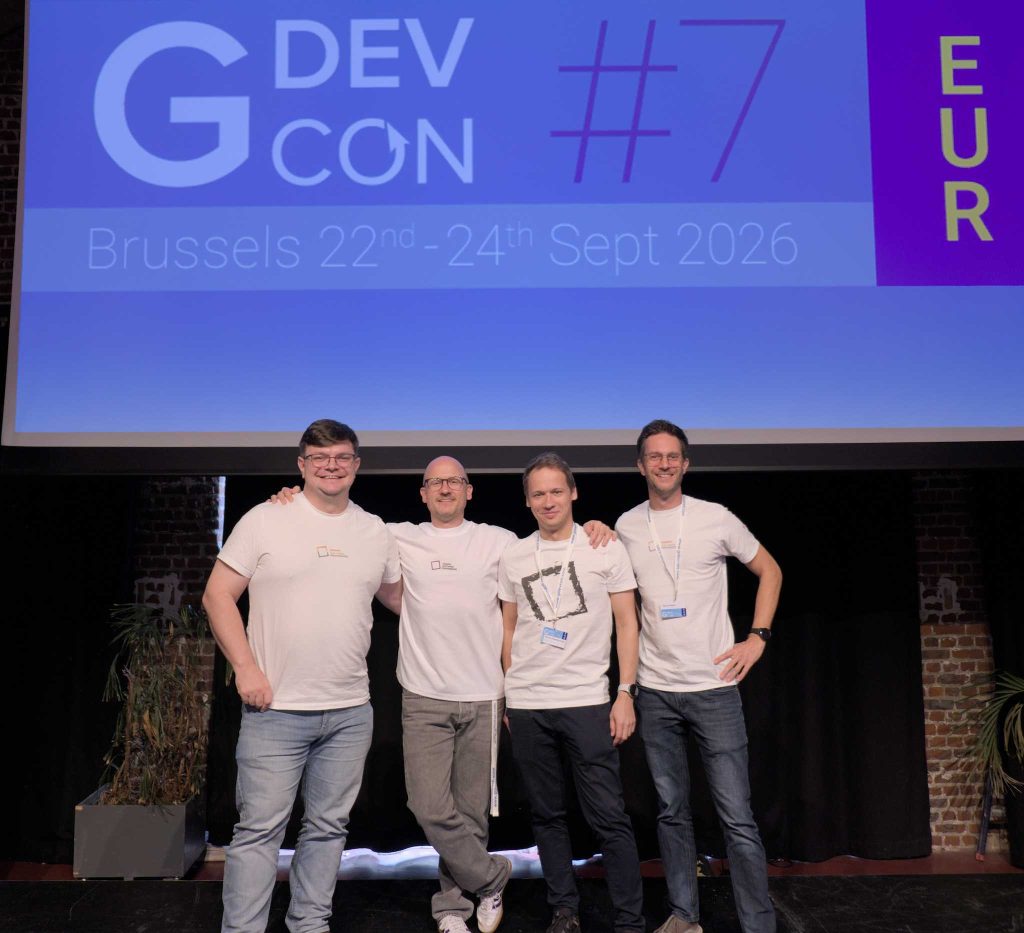
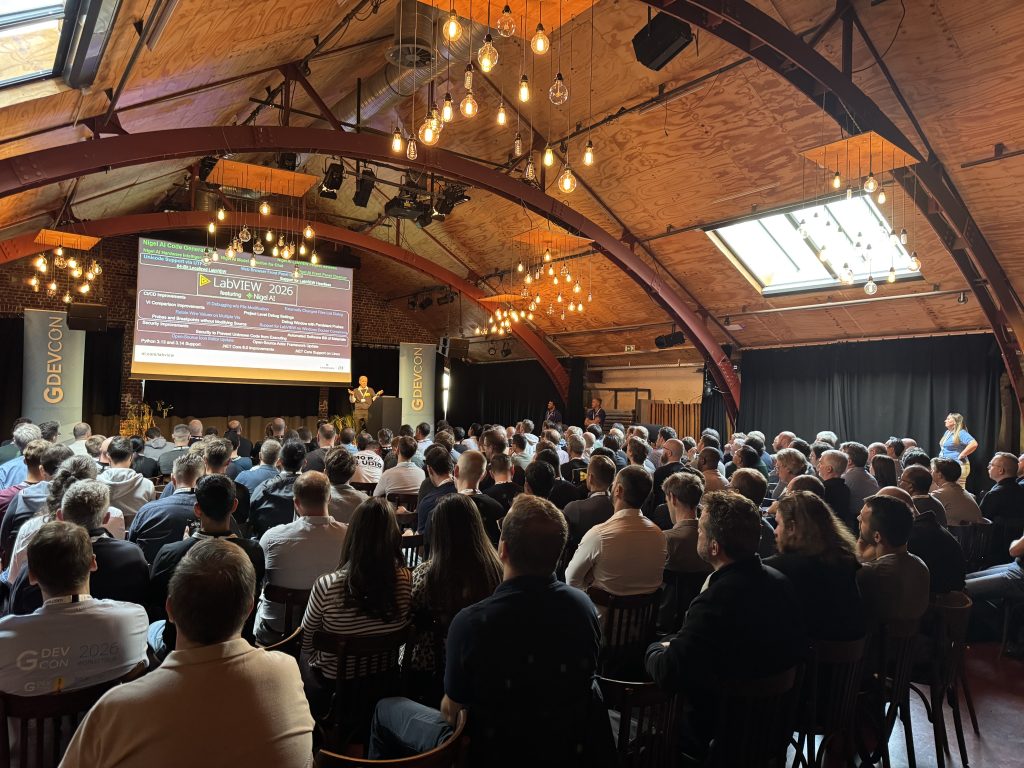
GDevCon #7 brought the international graphical programming community to Brussels from September 22–24, 2026. From cybersecurity and continuous integration to AI, software architecture, and real-world applications, the conference demonstrated just how much our community has to offer. For #teamhampelsoft, it was also an opportunity to share the latest developments of our HSE Application Template.
Brussels, Bouldering and Better Software
This year’s GDevCon Europe took place at La Tricoterie in Brussels, Belgium. After previous editions in Birmingham, Amsterdam, Stuttgart, and Brighton, the independent conference for graphical developers continued its journey through Europe.
GDevCon has always been close to our hearts. HSE was among the companies that founded the conference, with Jörg currently leading the organisation as the Chair person and Ioan joining the GDevCon organisers team recently. What started as an idea among a handful of developers has become an established international gathering, bringing together people who share a passion for LabVIEW and professional software engineering.
This year’s programme was particularly diverse. The organisers had expanded the number of presentations to accommodate more of the excellent submissions, including contributions from first-time GDevCon speakers.
But before the conference started, there was another important appointment.
Pre-Event Workout with LabVIEW Friends
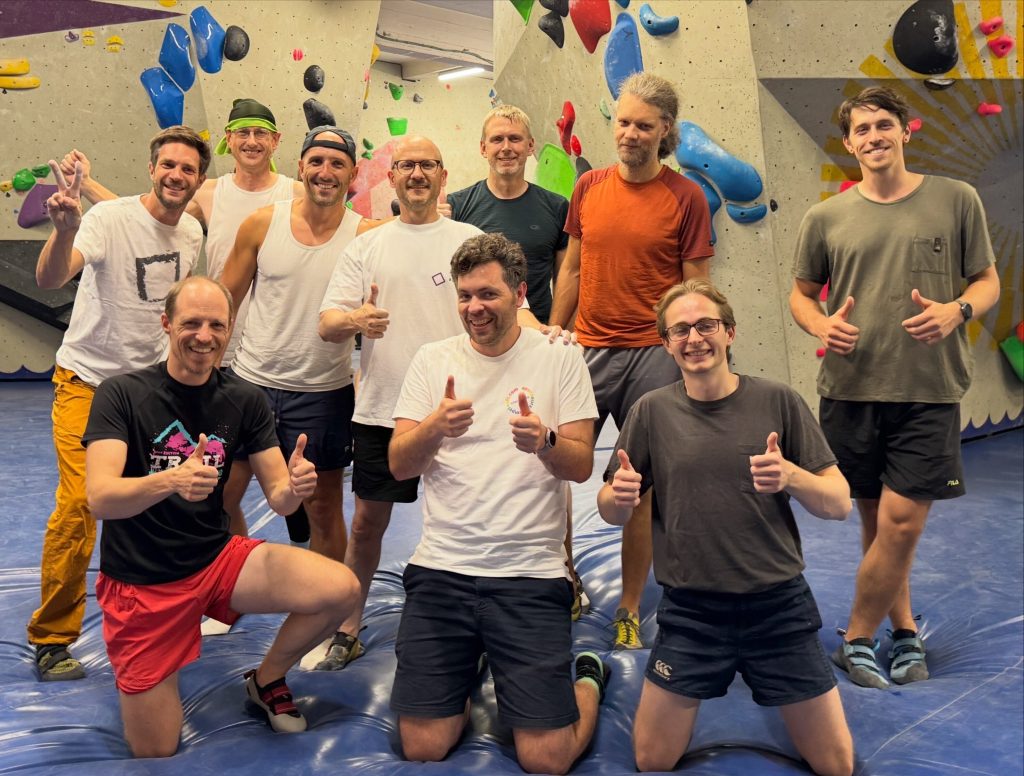
By now, meeting up with friends from the LabVIEW community for some climbing before a conference has become something of a tradition. For every LabVIEW event HSE attends, Joerg scouts the location and finds a bouldering gym nearby, then rallies the troops via social media for a comfy pre-event workout session.
Brussels was no exception. With an extra day before the conference, we took the opportunity to get together at a local bouldering gym. These sessions are much more than just a sporting activity. They’re an opportunity to catch up with friends, exchange ideas, and strengthen relationships that often go back many years.
#labviewfriends == #boulderfriends
Three Stories, Three Challenges: Jörg’s Opening Keynote
GDevCon #7 opened with a keynote by Jörg Hampel that focused on something more fundamental than any particular technology: community.
Jörg shared three personal stories about the beginnings of GDevCon, his first experiences with the international LabVIEW community, and the challenges facing our industry today. Each story came with a challenge for the audience:
- Talk to someone you don’t know. Communities don’t simply exist. People create them.
- Find one idea that challenges how you currently work. Sometimes the biggest improvements come from learning from others.
- Contribute and collaborate. Share what you learn, ask for help, and help others.
The keynote was very well received and set the tone for the entire conference. Its central message: We can only master the challenges ahead if we face them together as a community.
Watch Jörg’s keynote on YouTube

Technical Highlights: From CI/CD to Cybersecurity and AI
The conference programme covered an impressive range of topics, reflecting both the technological evolution of LabVIEW and the changing requirements facing professional software development teams.
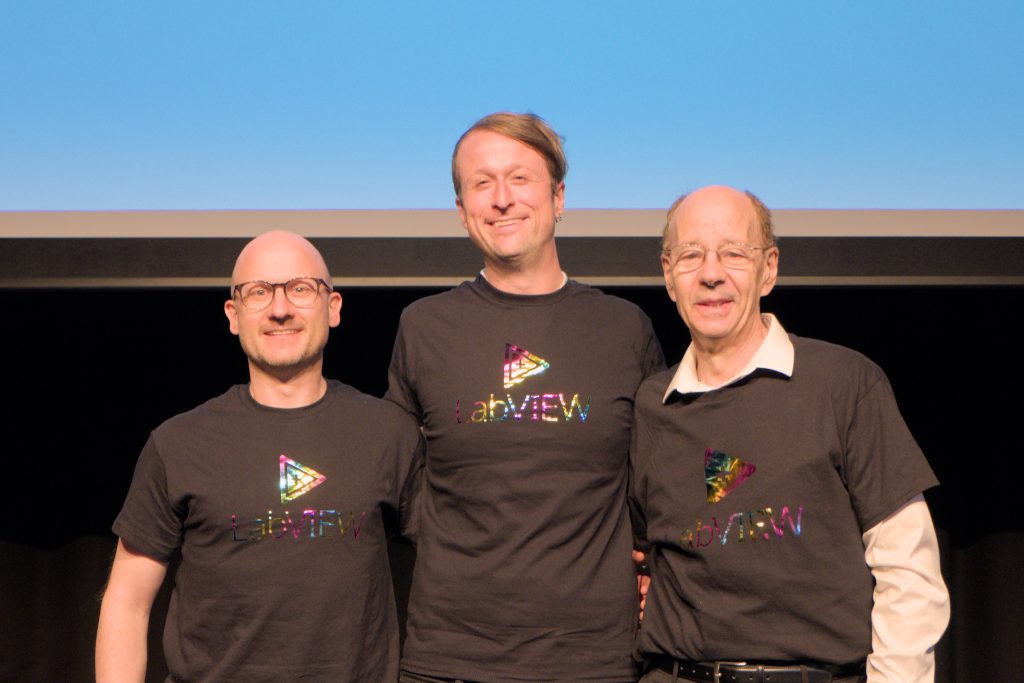
Tony Vento opened the technical programme with 40 Years of LabVIEW in Europe, providing a fascinating look back at LabVIEW’s history and the important role of its community. Olivier Jourdan followed with an entertaining and thoughtful presentation about becoming a better LabVIEW developer, reminding us that years of experience alone don’t necessarily make us better engineers.
Continuous Integration, containers, and AI-assisted development were recurring themes. Pawel Hanus demonstrated the practical use of Docker in a substantial test-bench project, while Venkatesh Perumal and Pranay Chandragiri presented an impressive CI/CD workflow combining containers, automated reviews, and AI-assisted development.
Cybersecurity was another major focus. Steve Summers (NI/Emerson), Sarah Zalusky, and Michal Kozák approached secure LabVIEW development from different perspectives, covering the European Cyber Resilience Act (CRA), dependency management, vulnerability tracking, and practical security measures in real-world projects.
These topics align closely with our own work at HSE, where we’re integrating secure engineering practices and demonstrable compliance into our development processes.
There was no shortage of deeply technical presentations either. From running LabVIEW FPGA code on non-NI hardware and mastering PXI triggers to advanced state machines and multithreading, there was something new to learn even for experienced developers.
One particularly impressive example was presented by Adarsha Pakala and Maximilian Meisinger, who demonstrated a regulated medical device application comprising approximately 11,000 VIs, complete with a remarkably polished user interface.
Artificial intelligence featured prominently on the third day. Jan Göbel introduced his open-source MCP Toolkit for LabVIEW, enabling AI clients to interact with LabVIEW applications and test systems.
The subsequent panel discussion, moderated by Jan Procházka, explored the opportunities, limitations, and risks of AI in test and measurement. Rather than following the hype, the discussion offered a refreshingly pragmatic perspective.
Other highlights included presentations on legacy system modernization, unit testing, observability, and modern LabVIEW user interfaces – all subjects that resonate strongly with our philosophy of creating better software.
And, of course, Chris Roebuck closed the technical programme with his entertaining collection of unconventional LabVIEW hacks.
Our Huddle: What’s Next for the HSE Application Template?
One of our own contributions to GDevCon #7 was a Huddle about the upcoming release of our HSE Application Template, the foundation for our DQMH-based LabVIEW applications (see https://dokuwiki.hampel-soft.com/code/dqmh/hse-application-template).
We presented recent improvements and discussed several architectural changes, particularly the separation of reusable framework code from project-specific application code.
Another important topic was dynamic loading of DQMH modules. We’re moving away from an INI-file-based module list toward a project-specific VI containing static VI references.
This preserves dynamic module loading while making the application’s composition visible directly in the LabVIEW source code. An important benefit is the possibility of automatically generating architectural documentation without relying on manually maintained configuration files.
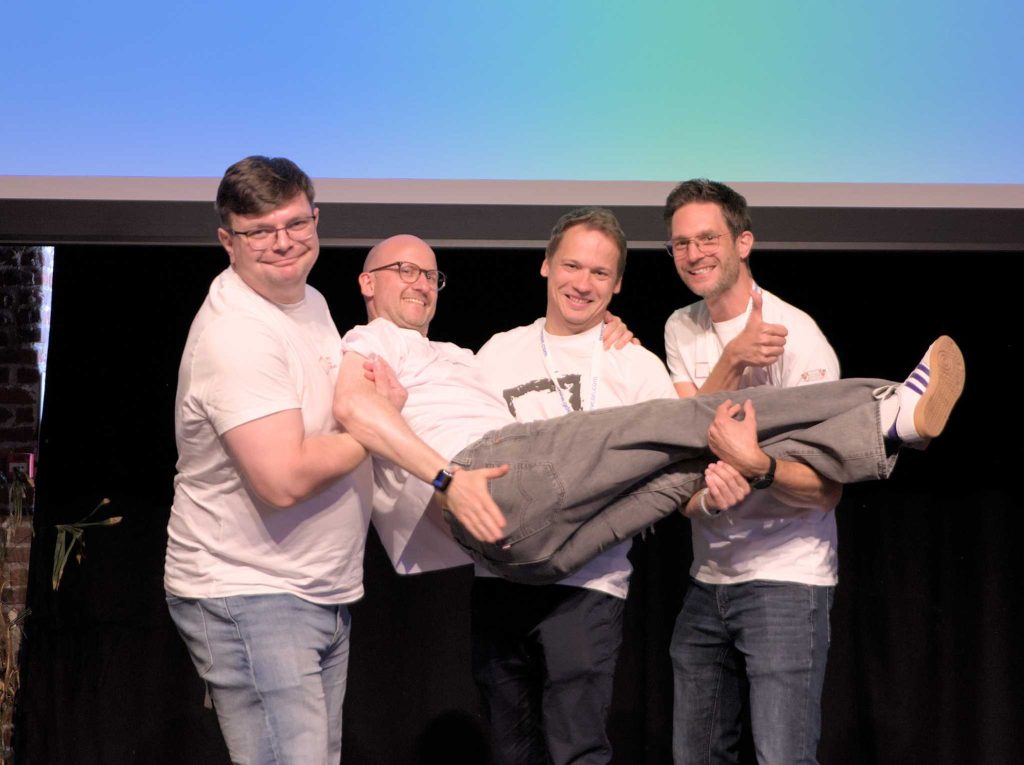
The Huddle provided an excellent opportunity to share our ideas, discuss design decisions, and gather feedback from fellow developers.
Beyond the Presentations: It’s All About the People
As always, the formal presentations were only part of the GDevCon experience. Between Huddles, coffee breaks, the Tech Cave, and the evening social at Wolf Sharing Market, there were countless opportunities to exchange ideas, discuss projects, and reconnect with friends.
For Jörg, the conference felt like 96 hours of almost uninterrupted conversations. Walking across the venue without meeting someone worth talking to was practically impossible.
We also enjoyed discussions about the future of DQMH, AI-assisted development, MCP-based tooling, and automated documentation—topics that connect directly to several initiatives we’re pursuing at HSE. These informal exchanges are often where the most valuable ideas emerge. Someone has solved a similar problem, developed an interesting tool, or found a completely different approach to a familiar challenge.
And sometimes it’s simply about spending time with people who have become good friends.
See You in Newcastle!
GDevCon #7 concluded with the traditional wrap-up by Ioan Polenciuc and Jörg Hampel, including the announcement that GDevCon #8 will take place in Newcastle, UK, in 2027!
A huge thank you goes to everyone who made this conference possible: the speakers, sponsors, volunteers, attendees, and the entire organising team. Special thanks, as always, to Jenny Bragg for her tireless work behind the scenes.
We left Brussels with plenty of new ideas, valuable technical insights, and renewed appreciation for the community we’ve helped build over the years. The challenges ahead – cybersecurity, AI, increasingly complex systems, and ever-growing expectations for software quality – aren’t getting any smaller. But GDevCon #7 reinforced something we strongly believe at HSE:
The best way to tackle these challenges is by learning from each other, sharing what we know, and working together to create better software.